Description
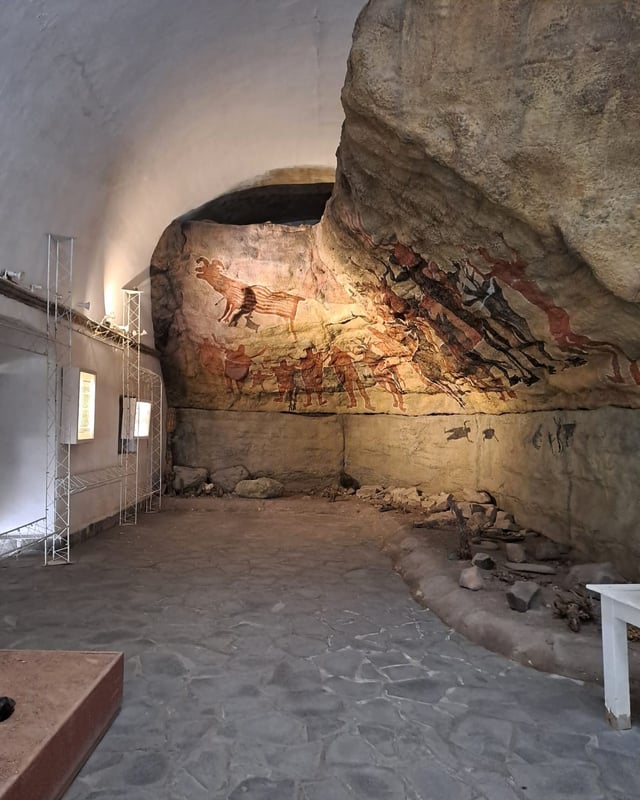
The area has some of the richest and most ancient cave paintings in the world. Dating back 8,800 years, these prehistoric paintings are in gullies, ravines and caves. They are remarkable for their size, quality and condition. The cave paintings were declared a UNESCO World Heritage Site in 1993.
Historical overview
The Baja California Peninsula is home to one of the most extraordinary collections of rock art in Mexico and the Americas. Its relative geographic isolation well into the 20th century allowed the indigenous peoples to develop complex cultural traditions with little outside influence. Among the most outstanding expressions of this heritage is the rock art created over thousands of years by the ancient groups that inhabited the region.
Within this vast heritage, the Sierra de San Francisco holds a special place, as it is home to some of the most spectacular and best-preserved rock art sites. This mountain range, with an area of approximately 3,600 km² and a maximum elevation of 1,590 meters above sea level, provided favorable conditions for the settlement of hunter-gatherer groups from the late Pleistocene—about 10,000 years ago—until the arrival of the Jesuit missionaries in the late 17th century. The unique combination of a dry climate, the natural protection provided by rock shelters, and the region’s difficult access has contributed to the exceptional preservation of these cultural expressions.
In addition to its extraordinary archaeological value, the Sierra de San Francisco stands out for the beauty of its landscapes, which feature canyons, plateaus, and a rich diversity of flora and fauna. This area is home to numerous rock art panels of great artistic quality, characterized by a predominantly realistic style depicting human figures, deer, bighorn sheep, pumas, birds, fish, and other animals, rendered using red, black, white, and yellow mineral pigments. Many of these figures are larger than life-size and were painted in elevated locations on the walls and ceilings of caves and rock shelters, which accentuates their monumental nature and visual impact. It is also common to find overlapping images, as well as numerous sites with petroglyphs that contain thousands of individual engravings.
The American historian and photographer Harry Crosby coined the term “Great Mural” to describe this extraordinary collection of rock art, a name that was widely accepted by the academic community. However, the earliest documented references to these works appear in the writings of 18th-century Jesuit missionaries. Later, in 1894, the French researcher Léon Diguet conducted significant explorations in the San Francisco and Guadalupe mountain ranges, providing the first scientific descriptions of these sites.
Archaeological research conducted over the past few decades has shown that the practice of painting and engraving on rock constituted a long-standing cultural tradition and an essential element of the worldview of the peninsula’s ancient inhabitants. Various European chroniclers and missionaries documented certain ceremonies, ritual objects, and symbolic practices of the indigenous peoples, many of which have been identified in both the rock art depictions and the artifacts recovered through archaeological excavations. These findings demonstrate the close relationship between rock art, religious beliefs, and the social organization of pre-Hispanic communities.
To preserve this exceptional heritage, various conservation and management measures have been implemented. At the most visited sites, trails, walkways, railings, fences, and interpretive signage have been installed to reduce the impact of tourism and protect the paintings. Access requires prior authorization and, in some cases, is only possible through guided tours. There are also more remote sites that can only be reached via long hikes or mule rides, which requires spending the night in camps set up for that purpose.
To support visitors, the INAH operates an information center in the town of San Ignacio, which features an introductory room with a photo exhibition, as well as a reservations and orientation center. This space provides information on the historical and cultural significance of the Sierra de San Francisco, authorized trails, access requirements, and recommendations for responsible visiting, thereby contributing to the conservation of one of Mexico’s most valuable archaeological heritage sites, which is internationally recognized as a UNESCO World Heritage Site.